SpotlightFood-service packaging and supplies distributor
Integrating Core Operations to Cut Supplier Costs and Expand Warehouse Capacity
A distributor with a team of 10 to 30, importing by the container, ran on more than ten disconnected tools, a full warehouse and supplier prices that had not been tested. The business was mapped end to end before any system was chosen, then moved onto one ERP. Storage more than quadrupled in the same building, and supplier costs fell 20 to 30% on every product re-sourced.
- 20 to 30%lower supplier costs
- 4.5x+storage, same floor space
- 3 monthsSales, costs and ops on one system
Industry
Food-service packaging and supplies distribution
Engagement
Fractional operations leadership, owning systems, warehouse and purchasing, ongoing
The challenge
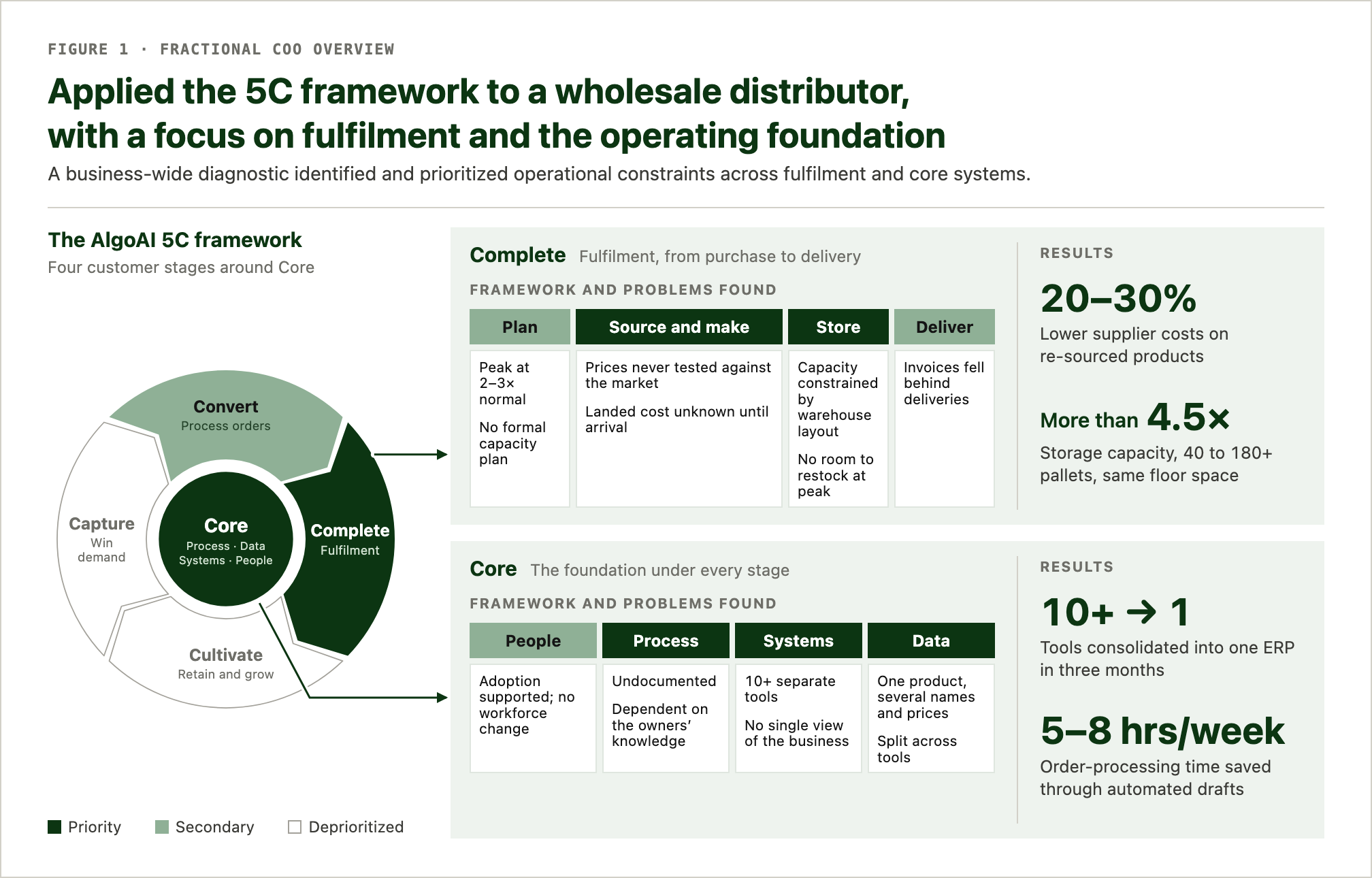
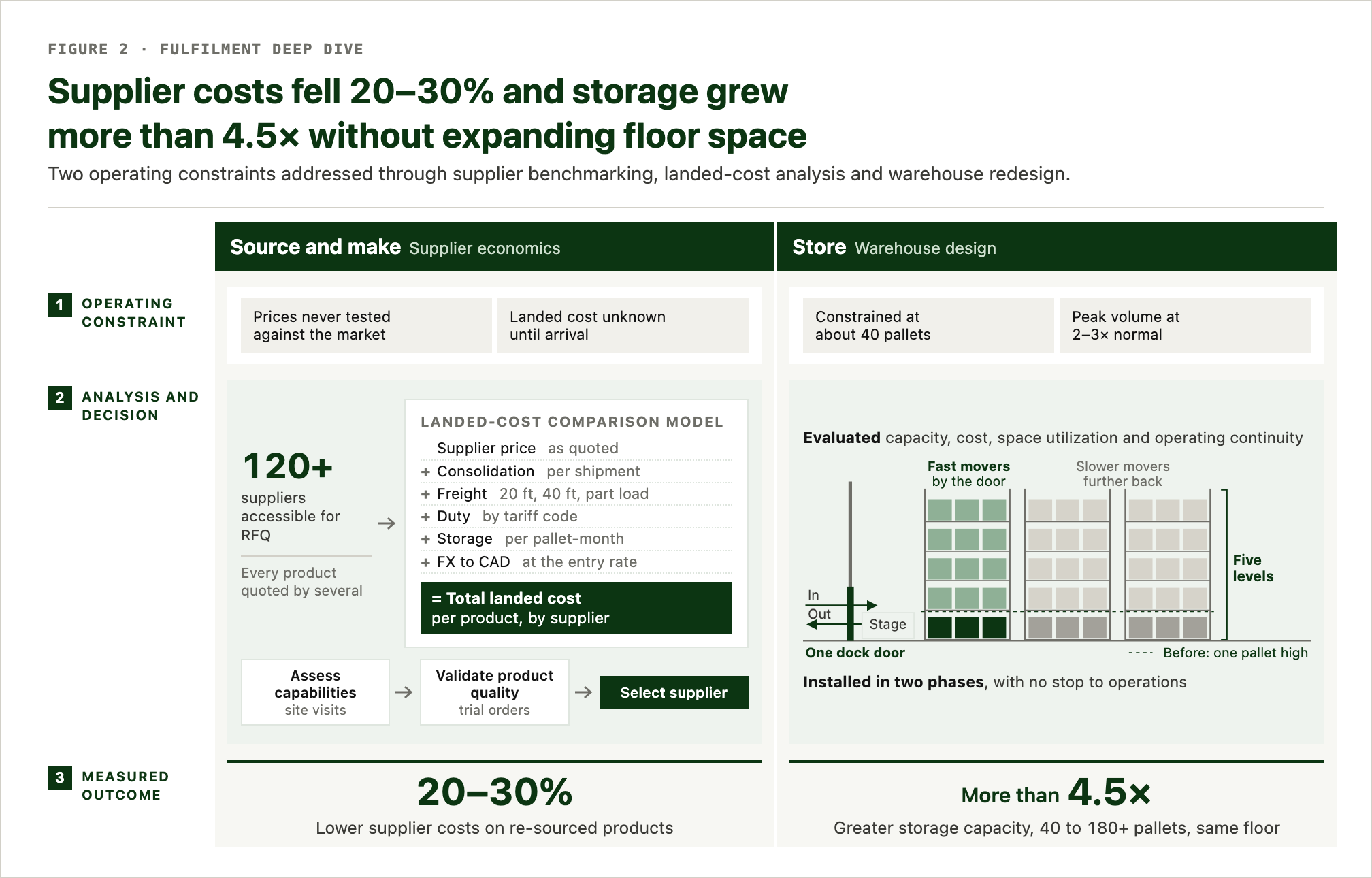
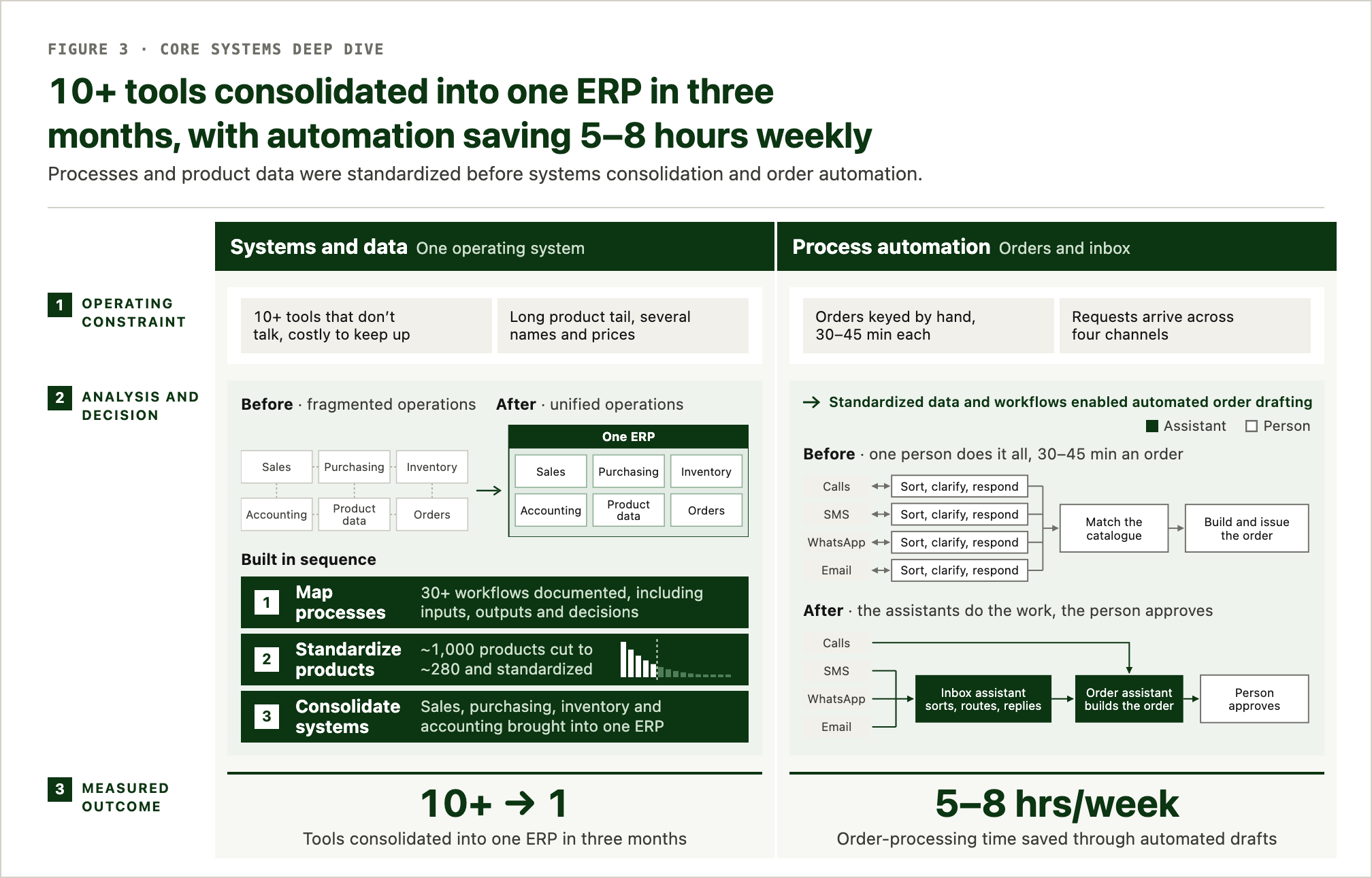
Orders arrived as texts and photos and were keyed in by hand, at 30 to 45 minutes an order. Invoicing, stock and customer messages each sat in a separate tool, so invoices fell behind deliveries and the owners had no single view of the business. The product list had no naming rule, and one product could carry several names and several prices. The warehouse had reached its practical limit at about 40 pallets, with peak season running at two to three times normal volume. Supplier prices had not been tested against the market, and landed cost was unknown until goods arrived.
The work
The business before the systemThe work began with a map of how the business runs, using AlgoAI's five-part framework: Capture, Convert, Complete, Cultivate and Core.Read more
It traced how customers are won, how a request becomes a quote and a quote becomes a sale, how orders are filled and delivered, and how customers are kept close. Only then was a system chosen. The choice was between a specialist tool for each step and one system that does most of it well, with one or two tools in support. The business took the second: fewer tools to run, at some cost to specialisation. Odoo replaced more than ten tools, Zoho among them.
A clean catalogueOne to two weeks of cleanup gave each product one name, one price and a place in a single library, and a full stock recount set the starting numbers.
Switching without stoppingThe old software ran until Odoo was ready, with paper as a stopgap in between.Read more
The first quarter on Odoo was set aside for the team to learn it and correct the data, and the owners accepted that the first year's numbers would be about 80% right and improve from there. The team resisted the new way of working at first. Resistance fell once the processes were written down and the time saved showed. Sales, costs and operations ran on Odoo within three months.
Built around how customers orderCustomers kept ordering in their own words, by chat, and no ordering format held for long.Read more
So the back end was built to absorb the variation: an order assistant reads each chat, matches the customer's wording to the catalogue and drafts the sales order for a person to approve. It began as a pilot on repeat orders, and each new step is tested before it expands. An inbox agent sorts the shared inbox every hour on weekdays and sends an evening summary.
WarehousePeak season turns stock two to three times faster, so the constraint was room to restock in time.Read more
Push-back, drive-in and automated racking were compared, and cost decided it: the lowest-cost system, built to the full height of the building. It went in over about a week, one half at a time, with stock moved across as each side was finished and no break in operations.
PurchasingEach product went out for competing quotes.Read more
Suppliers were visited in person to see their machines, capacity and ways of working, then trialled on smaller products to prove their quality before the owner agreed to switch. Each quote, shipment and duty rate is recorded, so the full landed cost is known before an order is placed.
Results
- 20 to 30%lower supplier costs on every product re-sourced, with no change for customers
- 40Storage up from 40 to more than 180 pallets in the same floor space
- Sales, costs and operations running on one ERP within three months
- 30 to 45Repeat orders that took 30 to 45 minutes to key in now arrive as drafts to approve
What stayed in place
One ERP the team runs on written processes, a product library under one naming rule, qualified suppliers with landed costs on file, and two automations that run without outside help.
More case studies
SpotlightUS consumer goods manufacturer
$60M+ a year in margin found
Improving Plant Throughput Through Floor-Level Diagnostics
- Up to 94% more capacity
- 30% output improvement in 2 weeks
Consumer goodsOperations and ProductivityCost and Margin
Read the caseUS pharmacy chain
10%+ labour savings
Assessing Specialty Prescription Centralization and a New Pill-Pack Service
- 25%+ less cash in stock
- $30M+ in working capital
Healthcare and life sciencesOperations and ProductivityCost and Margin
Read the caseBiotech company preparing a US launch
EU to US gene therapy launch
Designing US Gene Therapy Distribution and Supply Chain Ownership
- -80°C cold chain designed
- 5 drugs, 5 regions, 1 model
Healthcare and life sciencesOperations and ProductivityOperating Model and Workforce
Read the case
Not sure where your profit goes? Let's find out.
30 minutes with Usama. You'll leave knowing where to look first.
No obligation. We'll see together whether we're a fit.